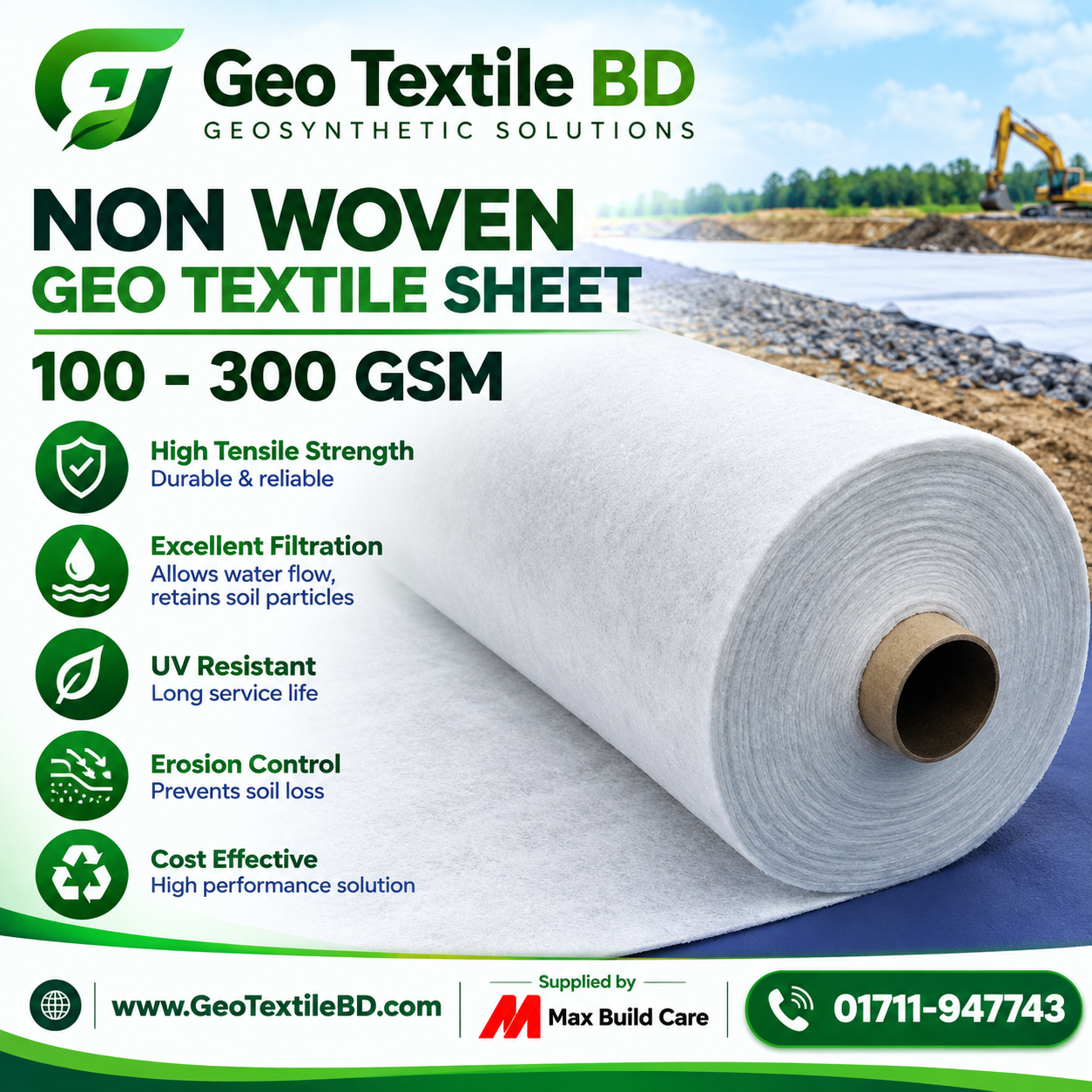
Non Woven Geotextile Sheet is a durable synthetic geotextile designed for filtration, drainage, separation, and erosion control. Its flexible fiber structure allows efficient water flow while preventing soil particle migration. Ideal for roads, drainage systems, foundations, retaining structures, landscaping, and civil engineering projects.
Non Woven Geotextile Sheet is a durable and versatile synthetic geosynthetic material designed primarily for filtration, drainage, separation, protection, and erosion-control applications. Manufactured from synthetic polymer fibers arranged into a non-woven structure, it provides excellent flexibility and allows water to pass through the fabric while helping prevent the migration of fine soil particles.
Non-woven geotextiles are widely used in modern civil engineering, road construction, drainage systems, foundations, retaining structures, landscaping, erosion control, and other infrastructure projects. Their combination of flexibility, permeability, durability, and filtration performance makes them an important material for managing soil and water effectively.
Non Woven Geotextile is a synthetic fabric manufactured by bonding or mechanically entangling polymer fibers rather than weaving them into a regular yarn pattern. The resulting fabric has a flexible, three-dimensional fiber structure with interconnected voids.
This structure allows water to flow through the geotextile while retaining soil particles. As a result, non-woven geotextiles are particularly suitable for applications where filtration and drainage are more important than high tensile reinforcement.
Depending on the product specification, non-woven geotextiles may be manufactured from polypropylene (PP), polyester (PET), or other suitable synthetic polymers.
The interconnected fiber structure allows water to pass through while helping prevent the migration of fine soil particles. This makes non-woven geotextile highly suitable for drainage and filtration applications.
Non-woven geotextiles can provide efficient water flow through the fabric, helping manage groundwater and drainage around structures.
The material helps prevent different soil and aggregate layers from mixing while still allowing water to pass through. This can help maintain the designed function of drainage and structural layers.
Unlike rigid construction materials, non-woven geotextile is flexible and can conform to irregular ground surfaces, making installation easier around foundations, drains, slopes, and other structures.
When used around waterproofing membranes, drainage systems, or other sensitive construction components, non-woven geotextile can provide a protective layer against mechanical damage caused by surrounding soil or aggregate.
The synthetic fiber construction provides good resistance to moisture and many common environmental conditions. The material is supplied in rolls, making transportation and installation convenient.
Non Woven Geotextile Sheet is widely used in:
One of the most important uses of non-woven geotextile is drainage. When installed around drainage aggregate or drainage pipes, the geotextile allows water to pass through while helping prevent surrounding soil particles from entering and clogging the drainage system.
This filtration function can help maintain drainage efficiency and reduce the movement of fine soil into drainage layers.
For foundation and retaining-wall drainage, non-woven geotextile can be installed between the soil and drainage aggregate. This creates a filtration layer that allows groundwater to reach the drainage system while helping keep soil particles separated.
Non-woven geotextile can also be used in road and pavement construction where separation and filtration are required.
When placed between soil and drainage or aggregate layers, it helps reduce the mixing of materials and supports the proper functioning of the drainage layer. The specific geotextile grade should be selected according to soil characteristics, traffic conditions, drainage requirements, and project design.
For applications requiring significant tensile reinforcement, a suitable woven geotextile or specialized geogrid may be more appropriate.
Before installation, the area should be prepared by removing sharp objects, large debris, roots, and other materials that could damage the geotextile.
The roll is then positioned over the prepared surface. Sheets should be properly aligned and overlapped according to the project specification.
For drainage applications, the geotextile should be placed carefully around the drainage aggregate or pipe so that it provides continuous filtration coverage.
Where necessary, the material can be temporarily secured using suitable pins, staples, or other fixing methods.
Aggregate or soil should be placed carefully over the geotextile to avoid unnecessary tearing or puncturing. Heavy construction equipment should not operate directly on exposed geotextile unless the installation design specifically permits it.
The correct geotextile should be selected according to project requirements. Important technical properties may include:
The required specification depends on the intended application, soil characteristics, drainage conditions, installation method, and expected loading.
Non Woven Geotextile rolls should be stored in a clean, dry, and protected area. Keep the rolls covered and protected from prolonged exposure to direct sunlight before installation.
During transportation and installation, avoid dragging the material over sharp surfaces or allowing it to come into contact with objects that may cause punctures or tears.
MAX BUILD CARE supplies Non Woven Geotextile Sheets for drainage, filtration, separation, foundation protection, road construction, retaining walls, landscaping, erosion control, and other civil engineering applications across Bangladesh.
Different GSM, roll sizes, material types, and technical specifications can be supplied according to project requirements.
For project-based or bulk requirements, customers can provide the required GSM, roll dimensions, application type, quantity, and technical specifications to obtain a suitable product and quotation.
Non Woven Geotextile Sheet is an effective geosynthetic solution for filtration, drainage, separation, protection, and erosion-control applications. Its flexible fiber structure allows water to pass efficiently while helping retain soil particles, making it particularly valuable in drainage and soil-management systems.
When correctly selected and installed, non-woven geotextile can help improve drainage performance, maintain separation between soil and aggregate layers, protect construction components, and contribute to the long-term performance of civil engineering and infrastructure projects.

Non Woven Geotextile Sheet is a durable synthetic geotextile designed for filtration, drainage, separation, and erosion control. Its flexible fiber structure allows efficient water flow while preventing soil particle migration. Ideal for roads, drainage systems, foundations, retaining structures, landscaping, and civil engineering projects.
Non Woven Geotextile Sheet is a durable and versatile synthetic geosynthetic material designed primarily for filtration, drainage, separation, protection, and erosion-control applications. Manufactured from synthetic polymer fibers arranged into a non-woven structure, it provides excellent flexibility and allows water to pass through the fabric while helping prevent the migration of fine soil particles.
Non-woven geotextiles are widely used in modern civil engineering, road construction, drainage systems, foundations, retaining structures, landscaping, erosion control, and other infrastructure projects. Their combination of flexibility, permeability, durability, and filtration performance makes them an important material for managing soil and water effectively.
Non Woven Geotextile is a synthetic fabric manufactured by bonding or mechanically entangling polymer fibers rather than weaving them into a regular yarn pattern. The resulting fabric has a flexible, three-dimensional fiber structure with interconnected voids.
This structure allows water to flow through the geotextile while retaining soil particles. As a result, non-woven geotextiles are particularly suitable for applications where filtration and drainage are more important than high tensile reinforcement.
Depending on the product specification, non-woven geotextiles may be manufactured from polypropylene (PP), polyester (PET), or other suitable synthetic polymers.
The interconnected fiber structure allows water to pass through while helping prevent the migration of fine soil particles. This makes non-woven geotextile highly suitable for drainage and filtration applications.
Non-woven geotextiles can provide efficient water flow through the fabric, helping manage groundwater and drainage around structures.
The material helps prevent different soil and aggregate layers from mixing while still allowing water to pass through. This can help maintain the designed function of drainage and structural layers.
Unlike rigid construction materials, non-woven geotextile is flexible and can conform to irregular ground surfaces, making installation easier around foundations, drains, slopes, and other structures.
When used around waterproofing membranes, drainage systems, or other sensitive construction components, non-woven geotextile can provide a protective layer against mechanical damage caused by surrounding soil or aggregate.
The synthetic fiber construction provides good resistance to moisture and many common environmental conditions. The material is supplied in rolls, making transportation and installation convenient.
Non Woven Geotextile Sheet is widely used in:
One of the most important uses of non-woven geotextile is drainage. When installed around drainage aggregate or drainage pipes, the geotextile allows water to pass through while helping prevent surrounding soil particles from entering and clogging the drainage system.
This filtration function can help maintain drainage efficiency and reduce the movement of fine soil into drainage layers.
For foundation and retaining-wall drainage, non-woven geotextile can be installed between the soil and drainage aggregate. This creates a filtration layer that allows groundwater to reach the drainage system while helping keep soil particles separated.
Non-woven geotextile can also be used in road and pavement construction where separation and filtration are required.
When placed between soil and drainage or aggregate layers, it helps reduce the mixing of materials and supports the proper functioning of the drainage layer. The specific geotextile grade should be selected according to soil characteristics, traffic conditions, drainage requirements, and project design.
For applications requiring significant tensile reinforcement, a suitable woven geotextile or specialized geogrid may be more appropriate.
Before installation, the area should be prepared by removing sharp objects, large debris, roots, and other materials that could damage the geotextile.
The roll is then positioned over the prepared surface. Sheets should be properly aligned and overlapped according to the project specification.
For drainage applications, the geotextile should be placed carefully around the drainage aggregate or pipe so that it provides continuous filtration coverage.
Where necessary, the material can be temporarily secured using suitable pins, staples, or other fixing methods.
Aggregate or soil should be placed carefully over the geotextile to avoid unnecessary tearing or puncturing. Heavy construction equipment should not operate directly on exposed geotextile unless the installation design specifically permits it.
The correct geotextile should be selected according to project requirements. Important technical properties may include:
The required specification depends on the intended application, soil characteristics, drainage conditions, installation method, and expected loading.
Non Woven Geotextile rolls should be stored in a clean, dry, and protected area. Keep the rolls covered and protected from prolonged exposure to direct sunlight before installation.
During transportation and installation, avoid dragging the material over sharp surfaces or allowing it to come into contact with objects that may cause punctures or tears.
MAX BUILD CARE supplies Non Woven Geotextile Sheets for drainage, filtration, separation, foundation protection, road construction, retaining walls, landscaping, erosion control, and other civil engineering applications across Bangladesh.
Different GSM, roll sizes, material types, and technical specifications can be supplied according to project requirements.
For project-based or bulk requirements, customers can provide the required GSM, roll dimensions, application type, quantity, and technical specifications to obtain a suitable product and quotation.
Non Woven Geotextile Sheet is an effective geosynthetic solution for filtration, drainage, separation, protection, and erosion-control applications. Its flexible fiber structure allows water to pass efficiently while helping retain soil particles, making it particularly valuable in drainage and soil-management systems.
When correctly selected and installed, non-woven geotextile can help improve drainage performance, maintain separation between soil and aggregate layers, protect construction components, and contribute to the long-term performance of civil engineering and infrastructure projects.
Lorem ipsum dolor sit amet, consectetur adipiscing elit. Ut elit tellus, luctus nec ullamcorper mattis, pulvinar dapibus leo.
Lorem ipsum dolor sit amet, consectetur adipiscing elit. Ut elit tellus, luctus nec ullamcorper mattis, pulvinar dapibus leo.
Lorem ipsum dolor sit amet, consectetur adipiscing elit. Ut elit tellus, luctus nec ullamcorper mattis, pulvinar dapibus leo.
Lorem ipsum dolor sit amet, consectetur adipiscing elit. Ut